Workouts
The Foundation 5×5: Ron’s Strength-First Program for Regular People
If you read my Strength First article, this is the program that goes with it. If you didn’t, here’s the short version: regular people don’t need complicated training. They need to get strong on a handful of movements, over and over, for longer than they think they need to.
That’s what this program does. It’s a 5×5 — five sets of five reps — built around five lifts that cover the entire body. Three sessions a week. No splits, no muscle confusion, no “we’re going to switch it up this week” nonsense. You run it until it stops working, which for most regular people takes 4 to 6 months. By the time it stops working, you’ll be a different person physically. That’s not a sales pitch. That’s just what happens when you actually build a strength base instead of chasing the next program.
I’ve put dozens of clients through some version of this. Below is the version I’ve landed on after enough trial and error to know what matters and what doesn’t.
What The Foundation 5×5 Actually Is
Two workouts. You alternate them. Workout A, then a rest day, then Workout B, then a rest day, then Workout A again. Each workout takes about 45 to 60 minutes once you know what you’re doing.
Here’s the structure:
Workout A
Squat — 5 sets of 5 reps
Bench Press — 5 sets of 5 reps
Barbell Row — 5 sets of 5 reps
Workout B
Squat — 5 sets of 5 reps
Overhead Press — 5 sets of 5 reps
Deadlift — 1 set of 5 reps
Same weight across all 5 sets — not a pyramid
Deadlift is 1×5 only — one heavy set is enough
That’s the entire program. Five movements. Three days a week. You’ll notice the deadlift is only one set of five, not five sets of five. There’s a reason for that and I’ll get to it.
You’ll also notice you squat every single workout. That’s not a typo. Most beginners need more squat practice than anything else, and squatting more often is how you get better at squatting. Don’t worry about it being “too much.” It’s not. I’ve yet to find a regular person who couldn’t recover from squatting three times a week at sensible weights.
The Schedule (How To Fit This Into A Normal Life)
Default schedule: Monday, Wednesday, Friday. Weekends off. This is what 90% of my clients run, and there’s a reason it works.
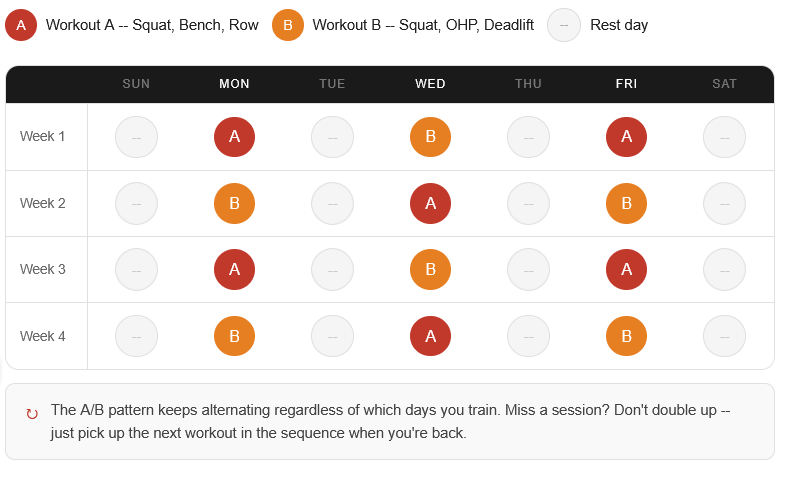
You get one rest day between every session. Weekends are clear for life — kids, family, errands, sleeping in, whatever. Most people work Monday to Friday and can build the gym into the bookends of their workday or their lunch break.
If Mon/Wed/Fri doesn’t fit your life, run it Tuesday/Thursday/Saturday. Or Sunday/Wednesday/Friday. The pattern is what matters, not the specific days. One rest day minimum between workouts. Alternate A and B each session.
Can you only train twice a week? That’s fine too. You’ll get roughly 80% of the strength gains compared to three days, which is still a massive improvement over the zero you’re getting from your old program. Just alternate A and B with one or two rest days between sessions.
What you don’t want to do is train four or five days a week as a beginner. I had a client named Derek who tried this against my advice. He was so excited about finally having a real program that he wanted to do it every other day plus add cardio days. Three weeks in, his squat stopped going up. His sleep got worse. He blamed the program. The program wasn’t the problem. He’d buried his recovery under enthusiasm. We pulled him back to three days, his squat started moving again within two weeks.
More isn’t better. Recovered is better.
The Five Movements (And Why These Five)
These five exercises cover every major muscle group in the body. There’s no missing piece you need to add in with a cable or a machine. Done correctly, this is complete.
Squat. The most important movement in the program. Hits your quads, glutes, hamstrings, lower back, core. Drives the hormonal response that makes the rest of the program work. If you only did one exercise for the rest of your life, this is the one. Coaching note: most beginners squat too high. Aim for hips below the top of your kneecap at the bottom. That’s “parallel” in lifter language. If you’re not sure, film yourself from the side. Almost everyone overestimates how deep they’re going.
Bench Press. The horizontal press. Hits your chest, shoulders, triceps. Coaching note: keep your shoulder blades pulled together and pressed into the bench. Don’t bounce the bar off your chest. Touch lightly, then drive.
Barbell Row. The horizontal pull. Hits your upper back, lats, rear delts, biceps. This is the counterbalance to the bench press, which is why we pair them in Workout A. Most desk-job adults are wildly out of balance in favor of their front side. Rows fix that. Coaching note: torso roughly parallel to the floor, pull the bar to your lower chest, don’t let your back round.
Overhead Press. The vertical press. Hits your shoulders, triceps, upper chest, core. This is the lift that tells the truth about your strength. You can cheat a bench press with leg drive and arch. You can’t cheat an overhead press. If your OHP is going up, you’re getting stronger for real. Coaching note: tighten your glutes and abs before you press. The bar travels in a straight line over the middle of your foot, not out in front of you.
Deadlift. The hip hinge (any movement where your hips drive backward while your spine stays neutral — picking something heavy up off the floor is the most common example). Hits your entire posterior chain — hamstrings, glutes, lower back, traps, grip. The deadlift is brutal. That’s why it’s only 1 set of 5 reps. One heavy set of five well-executed deadlifts will do more for you than five sets of mediocre ones. Coaching note: bar over middle of foot before you pull. Set your back tight. Push the floor away with your legs first, don’t yank with your arms.
Starting Weights (Don’t Be A Hero)
This is where most people screw up the program in the first two weeks. They start too heavy because their ego won’t let them start light. Then they grind through workouts that should have been easy, their form falls apart, they get sore, they get discouraged, and they quit at week 4 wondering why “the program didn’t work.”
Start LIGHT. I cannot say this strongly enough. Light enough that the first three or four workouts feel almost insultingly easy.
Why? Because the program’s engine is progression. You add weight every workout. If you start at a weight you can barely handle, you have nowhere to progress to. If you start light, you bank weeks of momentum before the weights get genuinely hard. By the time the program is challenging you, you’ve already grooved the form, built the habit of training, and your body is ready to actually grow.
Here’s what I tell clients:
Never lifted before: Start with the empty barbell on squat, bench press, and overhead press. The bar weighs 45 pounds. That is your starting weight. For rows and deadlifts, start with 65 to 95 pounds (you’ll need to add some small plates). Yes, the empty bar will feel light. That’s the point.
Returning after a layoff of 6+ months: Start with a weight you could lift for 10 reps. So if you used to bench 185 for 5, and you can probably do 155 for 10 right now, start at 155. Not 185. Not 175. 155. You’ll be back at 185 in 8 weeks anyway. Start where you are, not where you used to be.
“I’m pretty advanced, this doesn’t apply to me”: It probably does. I’ve had clients with five years of training history start this program and find out at week six that they were not as strong as they thought because they’d been substituting volume for actual progression. If you’re reading this and thinking you should start heavier, you are exactly the person who should start lighter.
Joanna, the client I mentioned in the Strength First article, was the worst offender on this. She wanted to start her squat at 95 pounds because “the bar feels too easy.” I made her start with the bar. She was annoyed with me for the first two weeks. By week six she was squatting 135 with perfect form, and by month four she was past 200. The light start is what made the heavy weights possible.
How To Warm Up Properly
Don’t skip this. The warmup isn’t optional and it isn’t just cardio on a treadmill.
The warmup for each lift is a series of progressively heavier sets that lead into your working sets. The point is to get your nervous system, joints, and muscles primed for the heavy weight, while also rehearsing the movement pattern at lighter loads.
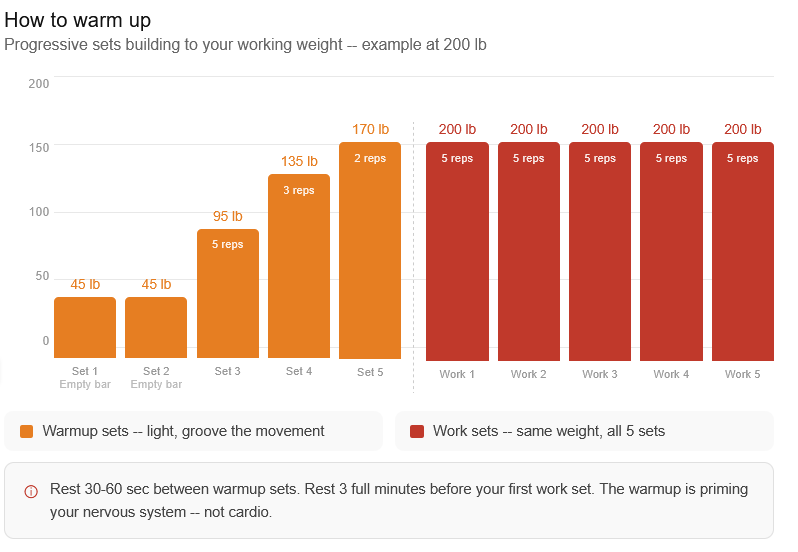
Here’s the structure I use with clients. Say your working weight on the squat is 200 pounds:
Set 1: Empty bar (45 lb) x 5 reps
Set 2: Empty bar (45 lb) x 5 reps
Set 3: 95 lb x 5 reps
Set 4: 135 lb x 3 reps
Set 5: 170 lb x 2 reps
Then your working sets: 200 lb x 5 reps, 5 reps, 5 reps, 5 reps, 5 reps
The warmup sets are not failure work. They should feel easy and crisp. You’re priming, not pre-fatiguing. Rest 30 to 60 seconds between warmup sets. Rest 3 minutes before your first working set.
You only need to do this full warmup for the FIRST lift of the day. For the second and third lifts, you can do a shorter version (1-2 warmup sets) because your body is already primed. Deadlift warmup is similar but you take bigger jumps because the deadlift starts from a dead stop and doesn’t need as much “groove” practice as the squat.
If you’re already warm and the working weight is light (say, under 100 pounds), you can simplify the warmup to two or three quick sets. As the weights get heavier over the months, the warmup gets longer. By the time you’re squatting 300+, your warmup might have 6 or 7 sets in it. That’s normal.
Sets, Reps, And Rest
Five sets of five reps. Same weight across all five sets. Not a top set with backoff sets. Not pyramiding up. The same weight, five times, for five reps each time.
This is harder than it sounds. Set one is easy. Set three is solid. Set five, with the same weight, is a fight. That’s by design. The last two sets are where most of the adaptation happens.
Deadlift is the exception. One set of five. Reason: deadlifts tax the entire system more than any other lift. Five sets of five at a heavy deadlift weight will destroy your recovery and bleed into your squat workouts. One heavy set, executed well, gives you the strength stimulus without the recovery cost.
Rest periods: This matters more than people think.
The default rule I give clients:
If the set felt easy: Rest 1 to 2 minutes. You’re not working hard enough yet to need more.
If the set felt normal: Rest 3 minutes. This is most sets, most of the time. Three minutes is the bread-and-butter rest period for this program.
If the set was brutal: Rest 5 minutes. Sometimes more. When you’re grinding out the last rep with everything you have, your nervous system needs longer to come back online for the next set. Don’t rush this. Trying to push through with inadequate rest is how form breaks down and how people get hurt.
If you watch experienced lifters at a serious gym, you’ll notice they rest a LOT longer between heavy sets than you’d think. There’s a reason for that. Strength work is not cardio. The rest is part of the program.
Progression: The Engine Of The Whole Thing
Here’s the rule, and it’s simple:
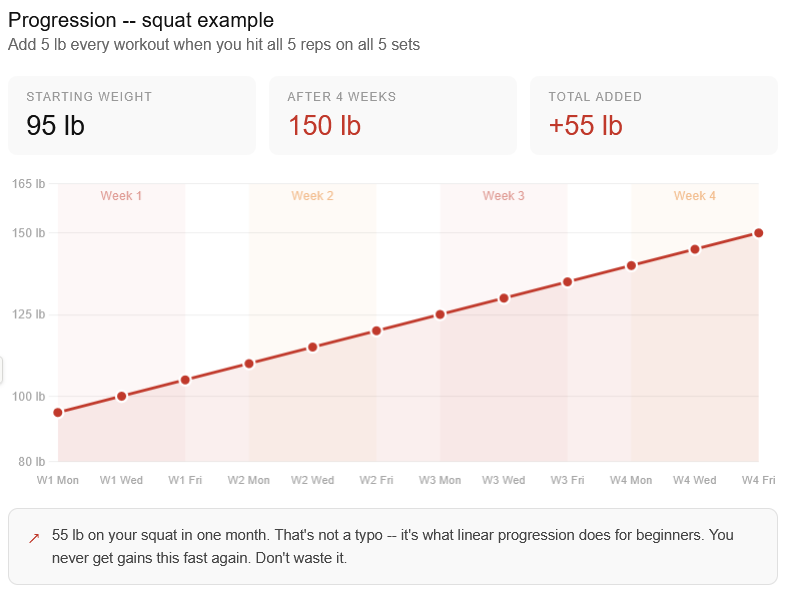
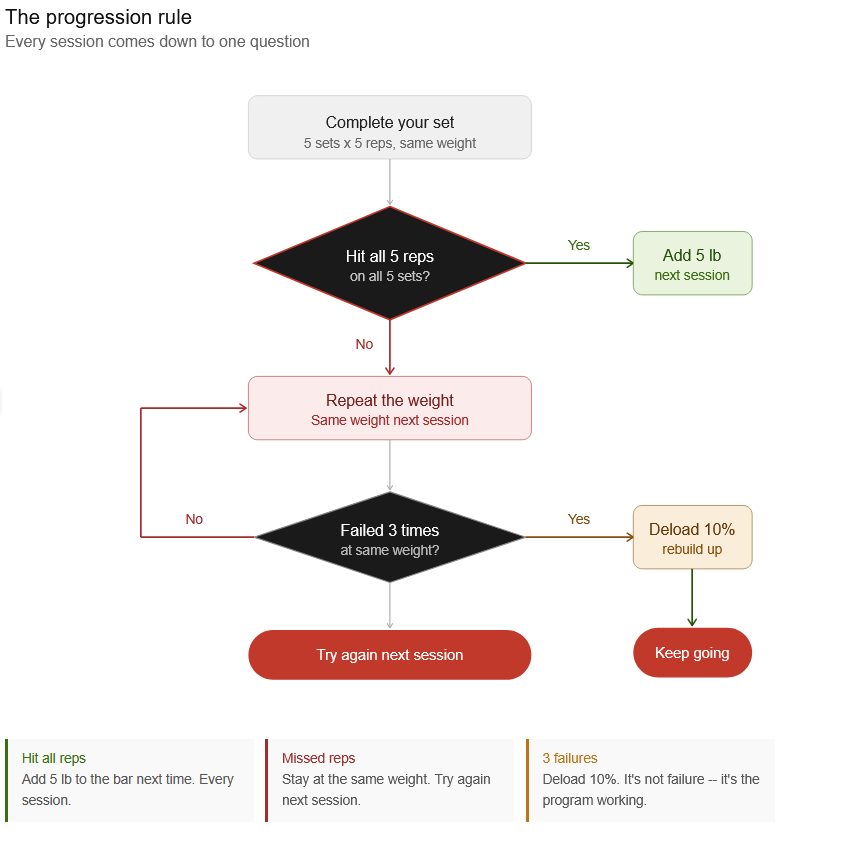
Hit all five reps on all five sets? Add 5 pounds next workout.
Missed reps anywhere? Stay at that weight next workout and try again.
That’s it. That’s the engine.
Strength work is not cardio. The rest is part of the program. Cutting rest short to feel like you’re working harder is the fastest way to stall your progress.
On deadlifts, where there’s only one set of five, you can add a bit more — 10 pounds per workout is fine because the absolute loads are higher and 5 pounds is a smaller percentage jump.
For the overhead press, you might find that 5 pounds is too much per workout after the first few weeks. The OHP uses small muscles compared to the squat or deadlift, and the loads stay relatively low. Many of my clients end up progressing the OHP by 2.5 pounds per session (using fractional plates) instead of 5. That’s fine. The principle is the same: small, consistent additions, workout after workout, for as long as they keep working.
Here’s what this looks like in practice on the squat:
Week 1: 95 lb, 100 lb, 105 lb
Week 2: 110 lb, 115 lb, 120 lb
Week 3: 125 lb, 130 lb, 135 lb
Week 4: 140 lb, 145 lb, 150 lb
That’s a 55-pound increase on your squat in four weeks. Looks unbelievable. Happens routinely with beginners who actually run the program as written.
The reason this works for so long is that beginners are massively undertrained. Your body is desperate for the stimulus. Linear weekly progression — small, steady additions — keeps providing that stimulus without overshooting. Eventually you’ll outgrow it. That’ll be 4 to 6 months in. We’ll talk about what to do then.
When Progress Stalls (The Honest Section)
Nobody runs this program forever without missing reps. The question is what you do when it happens.
Here’s the rule I use with clients:
First time you miss reps: Stay at the weight. Try again next workout. Make sure you slept, ate, and warmed up properly. Often a missed workout is a recovery issue, not a strength issue.
Second time you miss reps at the same weight: Stay at the weight one more time. Sometimes the third attempt is when it clicks.
Third time you miss reps at the same weight: Now it’s a real stall. Drop the weight by 10% and work your way back up. By the time you get back to where you stalled, you’ll usually punch through it because the lower weights gave your body a chance to consolidate.
This is called a deload (a planned reduction in weight, usually 10-15%, that lets your body recover and rebuild before pushing into new territory). It’s not a failure. It’s a feature of the program. Every linear progression eventually requires deloads. The lifters who understand this stay in the program. The lifters who don’t, quit and go looking for a new program. Don’t be that guy.
Different lifts stall at different rates. Your deadlift will progress longer than your squat. Your squat will progress longer than your bench. Your bench will progress longer than your overhead press. This is normal. You don’t need all four lifts moving at the same rate. You just need each lift to keep moving by SOME amount over time.
What you DO NOT do when you stall: switch programs, add a bunch of accessory work, start “muscle confusion” training, buy a new supplement, or convince yourself you’ve outgrown beginner programming. Almost everyone who quits this program quits because they got bored or impatient, not because the program stopped working.
Marcus, who I wrote about in my Strength First article, came back to me in 2014 after his first failed attempt at training. We started him on a version of this program. At month three, he stalled on his bench press for three workouts in a row. He texted me asking if we should change something. I told him to deload 10% and keep going. He was annoyed. He did it anyway. Two weeks later he was past his old sticking point and he never doubted me again.
What Happens Outside The Gym Matters As Much As What Happens Inside It
I’d be lying to you if I let you finish reading this thinking the program alone is enough.
The training is maybe 40% of why someone gets results on this program. The other 60% is what they’re doing the other 23 hours of the day. I learned this the hard way with Joanna and a couple of other clients before her. The training was right. The conditions underneath the training were sabotaging it.
The basics that matter:
Sleep. 7 to 9 hours. Non-negotiable for adaptation. Most of your strength gains and muscle building happen while you’re asleep. Skimp on sleep and you’re paying for membership at a gym whose results you’re throwing away every night.
Protein. At minimum, 0.8 grams per pound of bodyweight per day. So a 180-pound guy needs roughly 145 grams of protein daily. Most beginners eat about half this and wonder why they’re not building muscle. Protein is the raw material. You can’t build with materials you don’t have.
Calories. Eat enough. Most regular guys trying to add strength while in a calorie deficit will fight the program the entire time. If your goal is to get strong and add muscle, eat at maintenance or in a small surplus (200-300 calories above maintenance). Aggressive cuts and serious strength building don’t mix well, especially for beginners.
Hormonal environment. For most men over 35, this is where the wheels start coming off and people don’t realize it. Sleep, stress, and nutrition affect testosterone, growth hormone, cortisol, and thyroid function more than most people understand. If you’ve been training consistently, eating well, sleeping enough, and progress is still slower than it should be, the hormonal side is worth looking at seriously. That’s the territory my 30-Day Anabolic Alchemy course covers in depth — how to optimize testosterone and HGH naturally through training, nutrition, sleep, and supplementation. It’s the companion piece to a program like this one. The training builds the body. The hormonal work builds the environment that lets the body actually respond to the training.
Get the basics right and this program will do everything it promises. Ignore them and you’ll be the guy on the forum in six months asking why “5×5 didn’t work for me.”
Quick Reference: The Foundation 5×5
Schedule: 3 days/week, alternating Workouts A and B. Default: Mon/Wed/Fri.
Workout A: Squat 5×5, Bench Press 5×5, Barbell Row 5×5
Workout B: Squat 5×5, Overhead Press 5×5, Deadlift 1×5
Starting weight: Light. Then lighter. Then lighter than that.
Progression: Hit all 5 reps on all 5 sets? Add 5 lb next workout. Missed reps? Repeat the weight. Third stall? Deload 10% and rebuild.
Rest periods: 1-2 min if easy. 3 min normal. 5 min when brutal.
Warmup: Empty bar to working weight in 4-5 progressive sets. Full warmup on first lift only.
Duration: Run it until it stops working. For most regular people, that’s 4 to 6 months of consistent progress.
Print it. Put it on your fridge. Run the program. Don’t change anything for at least 12 weeks unless something specific in this article tells you to.
The first 12 weeks of consistent strength training will change more about your body than the previous 12 years of whatever you were doing before. I’ve watched it happen too many times to count. The only thing standing between you and that result is the discipline to keep the program boring and let the boring program do its work.

Ron Males is an ISSA Certified Nutrition Coach, strength coach, and longtime member of the original PowerandBulk legacy forum. Coaching clients since 2015, Ron specializes in grip strength training and the StrongFirst/strength-first philosophy - making proven powerlifting principles accessible to regular people. His foundation runs deep: personal training experience, comprehensive research into performance enhancement, testosterone optimization, and muscle building - combined with a working knowledge of biohacking and evidence-based supplementation. Ron is dedicated to cutting through misinformation and giving people straight, reliable information they can actually act on. His interests span herbs, adaptogens, and performance-enhancing compounds - not just for the gym, but for optimizing energy, focus, and output across all areas of life. As an occasional supplement reviewer at PowerandBulk.com, he brings the same no-BS standard to the bottle as he applies to the barbell — drawing on first-hand experience with bodybuilding supplements and a nutrition coaching background to deliver reviews readers can trust. A founding voice on the old forum, Ron continues to shape the training and supplement content that makes PowerandBulk.com what it is today. Read more about him.